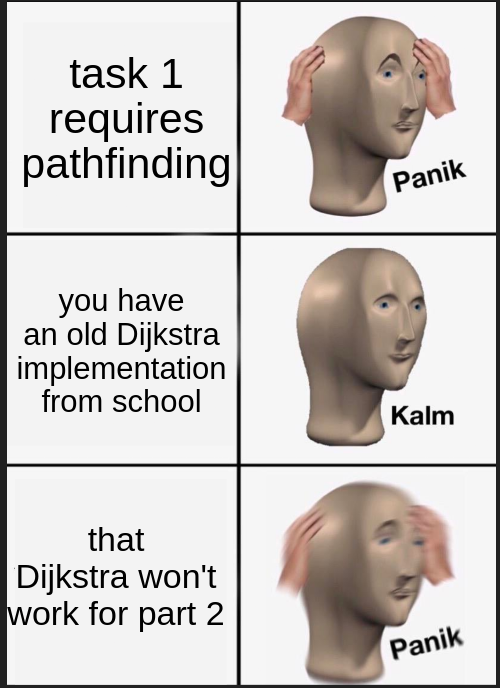
You’re right, iterating through the pairs does seem to be the way. After doing some analyzing of what takes how long, it seems my issue is with (quickly) figuring out whether I’ve already connected all nodes or not.
- 17 Posts
- 269 Comments
Joined 2 年前
Cake day: 2023年6月17日
You are not logged in. If you use a Fediverse account that is able to follow users, you can follow this user.
My algorithm is probably pretty horrible, I was purely out to get a solution as fast as possible. I might try improving it after Day12…
Kotlin
First tricky puzzle today, instantly leading me to more or less brute force for part2. I took a lot of time to understand which data structures I needed today, and how to compute my matrix.
Runtimes:
part1: 141ms
part2: 45.9 seconds .-.Solution
class Day08 : Puzzle {

    lateinit var boxes: List<Point3D>
    lateinit var edges: List<Pair<List<Point3D>, Double>>

    override fun readFile() {
        val input = readInputFromFile(2025, 8, false)
        boxes = input.lines().filter { it.isNotBlank() }
            .map { it.split(",") }
            .map { Point3D(it[0].toInt(), it[1].toInt(), it[2].toInt()) }
        edges = calculateEdges(boxes)
    }

    private fun calculateEdges(boxes: List<Point3D>): List<Pair<List<Point3D>, Double>> {
        val edges = mutableListOf<Pair<MutableList<Point3D>, Double>>()
        for (i in boxes.indices) {
            for (j in i + 1 until boxes.size) {
                edges.add(Pair(mutableListOf(boxes[i], boxes[j]), boxes[i].dist(boxes[j])))
            }
        }
        return edges.sortedBy { it.second }
    }

    override fun solvePartOne(): String {
        val connections = buildEmptyConnectionMatrix(boxes.size)
        val mutableEdges = edges.toMutableList()
        for (i in 0..<1000) {
            connectNextEdge(mutableEdges, connections)
        }

        val connectionSet = buildConnectionSet(boxes, connections)

        return connectionSet.map { it.size }
            .sortedByDescending { it }
            .take(3)
            .reduce(Int::times)
            .toString()
    }

    override fun solvePartTwo(): String {
        val connections = buildEmptyConnectionMatrix(boxes.size)
        val mutableEdges = edges.toMutableList()

        var result: Long? = null
        while (result == null) {
            result = connectNextEdge(mutableEdges, connections, true)
        }

        return result.toString()
    }

    // size: width & height of (square) matrix
    private fun buildEmptyConnectionMatrix(size: Int): Array<Array<Boolean>> {
        val connections = Array(size) { Array(size) { false } }
        for (i in connections.indices) {
            connections[i][i] = true
        }
        return connections
    }

    private fun connectNextEdge(mutableEdges: MutableList<Pair<List<Point3D>, Double>>, connections: Array<Array<Boolean>>, part2: Boolean = false): Long? {
        if (mutableEdges.isEmpty()) return null
        val next = mutableEdges[0]

        val point = next.first[0]
        val other = next.first[1]
        connectAll(boxes.indexOf(point), boxes.indexOf(other), connections)
        mutableEdges.remove(next)

        // all nodes are connected, assume that this is happening for the first time
        return if (part2 && connections[0].all { it }) {
            next.first[0].x.toLong() * next.first[1].x.toLong()
        } else {
            null
        }
    }

    private fun connectAll(index: Int, other: Int, connections: Array<Array<Boolean>>) {
        fun connectHelper(hIndex: Int) {
            val newConnections = mutableSetOf<Int>()
            for (i in connections[hIndex].indices) {
                if (connections[hIndex][i]) newConnections.add(i)
            }
            for (boxIndex in newConnections.filter { it != hIndex }) {
                for (conn in newConnections.filter { it != boxIndex }) {
                    connections[boxIndex][conn] = true
                }
            }
        }
        connections[index][other] = true

        connectHelper(index) // update matrix with all values from node at [index]
        connectHelper(other) // update matrix with all values from node at [other]
    }

    // returns 2D-list of all indices of currently active connections
    private fun buildConnectionSet(boxes: List<Point3D>, connections: Array<Array<Boolean>>): Set<List<Int>> {
        val connectionSet = mutableSetOf<List<Int>>()
        val indices = (0 until boxes.size).toMutableList()
        while (indices.isNotEmpty()) {
            val list = mutableListOf<Int>()
            val curr = indices.removeFirst()
            val array = connections[curr]
            for (j in array.indices) {
                if (array[j]) list.add(j)
            }
            connectionSet.add(list)
        }
        return connectionSet
    }

    data class Point3D(val x: Int, val y: Int, val z: Int) {
        fun dist(other: Point3D): Double {
            return sqrt(
                (x - other.x).toDouble().pow(2) +
                        (y - other.y).toDouble().pow(2) +
                        (z - other.z).toDouble().pow(2)
            )
        }
    }
}
full code on Codeberg

 3·6 天前
I usually use Longs by default too, but this year I mostly got by with Ints, so I’ve stuck to Ints for less memory (my solutions tend to be rather inefficient in that regard .-.)
Kotlin
Tried recursive for part1, didn’t work. LUCKILY for once I was smart and committed anyway, as it was the right solution for part2! I was losing my mind for a bit though as I had originally written my method with Integers…
Solution
class Day07 : Puzzle {

    val grid = mutableListOf<MutableList<Char>>()
    val partTwoCache = mutableMapOf<Pair<Int, Int>, Long>()

    override fun readFile() {
        val input = readInputFromFile(2025, 7, false)
        for (line in input.lines().filter { it.isNotBlank() }) {
            grid.add(line.toCharArray().toMutableList())
        }
    }

    override fun solvePartOne(): String {
        grid[1][grid[0].indexOf('S')] = '|'

        var splits = 0
        for (r in 1..<grid.size - 1) {
            for (c in 0..<grid[r].size) {
                if (grid[r][c] == '|') {
                    if (grid[r+1][c] == '.') {
                        grid[r+1][c] = '|'
                    } else if (grid[r+1][c] == '^') {
                        grid[r+1][c-1] = '|'
                        grid[r+1][c+1] = '|'
                        splits++
                    }
                }
            }
        }
        return splits.toString()
    }

    override fun solvePartTwo(): String {
        val start = grid[0].indexOf('S')
        return (1 + processBeamPartTwo(1, start)).toString() // don't forget to count the original timeline
    }

    private fun processBeamPartTwo(row: Int, column: Int): Long {
        if (partTwoCache.contains(Pair(row, column))) {
            return partTwoCache[Pair(row, column)]!!
        }

        if (row == grid.size) return 0L
        if (column == grid[row].size || column < 0) return 0L

        val out = if (grid[row][column] == '^') { // splitter
            1L + processBeamPartTwo(row, column - 1) + processBeamPartTwo(row, column + 1)
        } else {
            processBeamPartTwo(row + 1, column)
        }
        partTwoCache[Pair(row, column)] = out
        return out
    }
}
full code on Codeberg
Kotlin
I’m not fully happy with my parsing today, but oh well. I also thought about just plain building the grid and then rotating it, but “normal input parsing” works too.
Solution
class Day06 : Puzzle {

    val numsPartOne = mutableListOf<MutableList<Long>>()
    val numsPartTwo = mutableListOf<List<Long>>()
    val ops = mutableListOf<(Long, Long) -> Long>()

    override fun readFile() {
        val input = readInputFromFile("src/main/resources/a2025/day06.txt")
        val lines = input.lines().filter { it.isNotBlank() }

        // parse part1 input
        for (line in lines.dropLast(1)) {
            for ((c, num) in line.trim().split(" +".toRegex()).withIndex()) {
                if (numsPartOne.getOrNull(c) == null) numsPartOne.add(mutableListOf())
                numsPartOne[c].add(num.toLong())
            }
        }

        // parse part2 input
        var numList = mutableListOf<Long>()
        for (c in 0..<lines.maxOf { it.length }) {
            var numStr = ""
            for (r in 0..<lines.size - 1) {
                numStr += lines[r].getOrElse(c) { ' ' }
            }
            if (numStr.isBlank()) {
                numsPartTwo.add(numList)
                numList = mutableListOf()
            } else {
                numList.add(numStr.trim().toLong())
            }
        }
        numsPartTwo.add(numList)

        // parse operators
        ops.addAll(
            lines.last().split(" +".toRegex())
                .map { it.trim()[0] }
                .map {
                    when (it) {
                        '*' -> { a: Long, b: Long -> a * b }
                        '+' -> { a: Long, b: Long -> a + b }
                        else -> throw IllegalArgumentException("Unknown operator: $it")
                    }
                }
        )
    }

    override fun solvePartOne(): String {
        return numsPartOne.mapIndexed { c, list -> list.reduce { a, b -> ops[c](a, b) } }.sum().toString()
    }

    override fun solvePartTwo(): String {
        return numsPartTwo.mapIndexed { c, list -> list.reduce { a, b -> ops[c](a, b) } }.sum().toString()
    }
}
full code on Codeberg
Kotlin
I first solved the puzzle with my own horrible range-merging algorithm, had quite a few nasty off by one errors. I quickly replaced it with the “normal” merge-algorithm after getting the right solution.
If you really want to see my abomination, it’s still in the commits on my repo.
Solution
class Day05 : Puzzle {

    val validIds = mutableSetOf<LongRange>()
    val ids = mutableListOf<Long>()

    override fun readFile() {
        val input = readInputFromFile("src/main/resources/a2025/day05.txt")
        val inputList = input.split("\n\n", limit = 2)
        validIds.addAll(
            inputList[0].lines().filter { it.isNotBlank() }
                .map { it.split("-").map { it.toLong() } }
                .map { LongRange(it[0], it[1]) }
        )
        ids.addAll(inputList[1].lines().filter { it.isNotBlank() }.map { it.toLong() })
    }

    override fun solvePartOne(): String {
        return ids.count { id -> validIds.any { id in it } }.toString()
    }

    override fun solvePartTwo(): String {
        val idsSorted = validIds.sortedBy { it.first }
        val merged = mutableSetOf<LongRange>()

        var current = idsSorted.first()
        for (i in 1..<idsSorted.size) {
            val next = idsSorted[i]

            if (next.first <= current.last) {
                current = LongRange(current.first, max(current.last, next.last()))
            } else {
                merged.add(current)
                current = next
            }
        }
        merged.add(current)
        return merged.sumOf { it.last + 1 - it.first }.toString()
    }
}
full code on Codeberg
Kotlin
Pretty simple solution, just plain count / remove the rolls until none can be removed anymore. I would’ve liked to try using imaginary numbers this year (due to this article), but sadly Kotlin doesn’t natively support them and I was too lazy to use a library.
Solution
class Day04 : Puzzle {

    val grid = mutableListOf<MutableList<Char>>()

    override fun readFile() {
        val input = readInputFromFile("src/main/resources/a2025/day04.txt")
        for ((r, line) in input.lines().filter(String::isNotBlank).withIndex()) {
            grid.add(mutableListOf())
            for (char in line) {
                grid[r].add(char)
            }
        }
    }

    override fun solvePartOne(): String {
        return countRolls(grid).toString()
    }

    override fun solvePartTwo(): String {
        var sum = 0
        var removed = -1
        while (removed != 0) {
            // main grid is modified here, not the best but doesn't really matter
            // also no idea how to clone 2D list in Kotlin
            removed = countRolls(grid, true)
            sum += removed
        }
        return sum.toString()
    }

    private fun countRolls(grid: MutableList<MutableList<Char>>, removeRolls: Boolean = false): Int {
        val dr = listOf(-1, -1, -1, 0, 0, 1, 1, 1)
        val dc = listOf(-1, 0, 1, -1, 1, -1, 0, 1)

        var sum = 0
        for (r in grid.indices) {
            for (c in grid[r].indices) {
                if (grid[r][c] != '@') continue

                var neighborCount = 0
                for (i in dr.indices) {
                    if (gridGet(grid, r + dr[i], c + dc[i]) == '@') neighborCount++
                }
                if (neighborCount < 4) {
                    sum++
                    if (removeRolls) grid[r][c] = '.'
                }
            }
        }
        return sum
    }

    private fun gridGet(grid: List<List<Char>>, r: Int, c: Int, default: Char = '.'): Char {
        return if (r in grid.indices && c in grid[r].indices) {
            grid[r][c]
        } else {
            default
        }
    }
}
full code on Codeberg
Yeah, I vaguely remember reading something about how close string splitting is to all the logarithm math in splitting numbers, and since then I’ve just always used strings because that’s way more intuitive to me lol
Nice! I thought about using numbers but then decided that strings are a lot easier to deal with.
Kotlin
First day this year where I am very happy with my solution. Just super simple, recursive string building.
Solution
class Day03 : Puzzle {

    val banks = mutableListOf<String>()

    override fun readFile() {
        val input = readInputFromFile("src/main/resources/a2025/day03.txt")
        banks.addAll(input.lines().filter(String::isNotBlank))
    }

    override fun solvePartOne(): String {
        val sum = banks.map { buildNumber(it, 2) }.sumOf { it.toLong() }
        return sum.toString()
    }

    override fun solvePartTwo(): String {
        val sum = banks.map { buildNumber(it, 12) }.sumOf { it.toLong() }
        return sum.toString()
    }

    private fun buildNumber(bank: String, remainingDigits: Int): String {
        if (remainingDigits <= 0) return ""
        val current = bank.dropLast(remainingDigits - 1)
        val max = current.max()
        return max + buildNumber(bank.split(max, limit = 2)[1], remainingDigits - 1)
    }
}
full code on Codeberg
Kotlin
got up early for this one, sadly it took me over 30 minutes to realize, that my code at the time was also considering a single digit valid .-.
also still pretty scuffed, but hey it works:
Solution
class Day02 : Puzzle {

    val ids = mutableSetOf<String>()

    override fun readFile() {
        val input = readInputFromFile("src/main/resources/a2025/day02.txt")
        ids.addAll(
            input.replace("\n", "")
                .split(",")
                .map { it.split("-") }
                .map(this::buildList)
                .flatten()
        )
    }

    private fun buildList(rangeList: List<String>): List<String> {
        val start = rangeList[0].toLong()
        val end = rangeList[1].toLong()
        val ids = mutableListOf<String>()
        for (i in start..end) {
            ids.add(i.toString())
        }
        return ids
    }

    override fun solvePartOne(): String {
        return ids.filter(this::idNotValid)
            .sumOf(String::toLong).toString()
    }

    override fun solvePartTwo(): String {
        return ids.filter { idNotValid(it, true) }
            .sumOf(String::toLong).toString()
    }

    private fun idNotValid(id: String, multipleSplits: Boolean = false): Boolean {
        val length = id.length

        // try all splits
        var split = 2
        while (split <= length) {
            if (length % split == 0) {
                val splits = mutableListOf<String>()
                var beg = 0
                var end = length / split
                val step = end
                for (i in 0..<split) {
                    splits.add(id.substring(beg, end))
                    beg += step
                    end += step
                }
                if (splits.all { it == splits[0] }) return true
            }
            if (multipleSplits) {
                split++
            } else {
                break
            }
        }
        return false
    }
}
full code on Codeberg
Kotlin
already rather scuffed for day1, but works:
https://codeberg.org/Eco-Gaming/AdventOfCode/src/branch/main/src/main/kotlin/a2025/puzzles/Day01.kt
Is the join code somewhere central / could you share it here?
Edit: My client hides read post, it’s literally a pinned post in this community: https://programming.dev/post/6631465
This toot is a response to a very similar question from someone else.
Also keep in mind, LTS versions always offer 5 years of support, so the current PopOS 22.04 LTS will receive support until April 2027, and the new PopOS 24.04 LTS will receive updates until April 2029.

PopOS isn’t going anywhere?
They’ve been working on their own Desktop Environment (COSMIC) for quite a while, an alpha and a beta already exists and the release is planned for December 11th (source).

It depends, some better Bluetooth headphones (like the Sony WH-1000XM family) support protocols other than SBC, which have a lot higher bandwidth.
For me I’d just say oh well, gotta fix it when I’m home again.
Otherwise I’d probably write some script on the server, which reboots my router when the server either doesn’t have internet anymore or can’t ping itself.










Oh wow, I see you went the Kotlin way of hacking together an object with Pairs and Triples. I used to do that too but then it got too confusing lol